 Transitour
Revenue Reporting for Coach Operators: What AI-Powered Tour Operator Software Can Automate

Revenue reporting for coach operators is not only a finance task. For many transport companies, it is the only way to understand which bookings are profitable, which quotes convert, which vehicles are underused and where operational work is creating hidden cost.
The problem is that revenue data often sits in different places. A quote is prepared in one spreadsheet. A confirmed trip is tracked in a calendar. The dispatcher manages changes by phone or WhatsApp. Invoices are created later in an accounting tool. By the time the manager wants to know what happened this month, the team has to rebuild the story manually.
For coach operators, bus companies, DMCs and transport teams, this creates a practical problem: the business may be busy, but not necessarily more profitable. More requests, more vehicles and more bookings only help if the company can see what is being sold, delivered, invoiced and paid.
Why revenue reporting for coach operators is hard to manage manually
Coach operations are not simple transactions. A single booking can involve several stops, different vehicle types, driver availability, luggage requirements, waiting time, customer-specific pricing, operational changes and post-service invoicing.
When the workflow is manual, every handoff creates a reporting gap. Sales may know how many quotes were sent. Dispatch may know which services were completed. Finance may know which invoices are still pending. But management rarely has one clear view of the full commercial and operational picture.
This makes it harder to answer questions such as:
- How much revenue has been confirmed this month?
- Which bookings are still pending payment?
- How many quotes became confirmed jobs?
- Which clients generate repeated work?
- Which vehicles are booked often and which remain idle?
- Which services are completed but not yet invoiced?
These are not abstract reporting questions. They affect pricing, staffing, fleet planning, cash flow and sales follow-up.
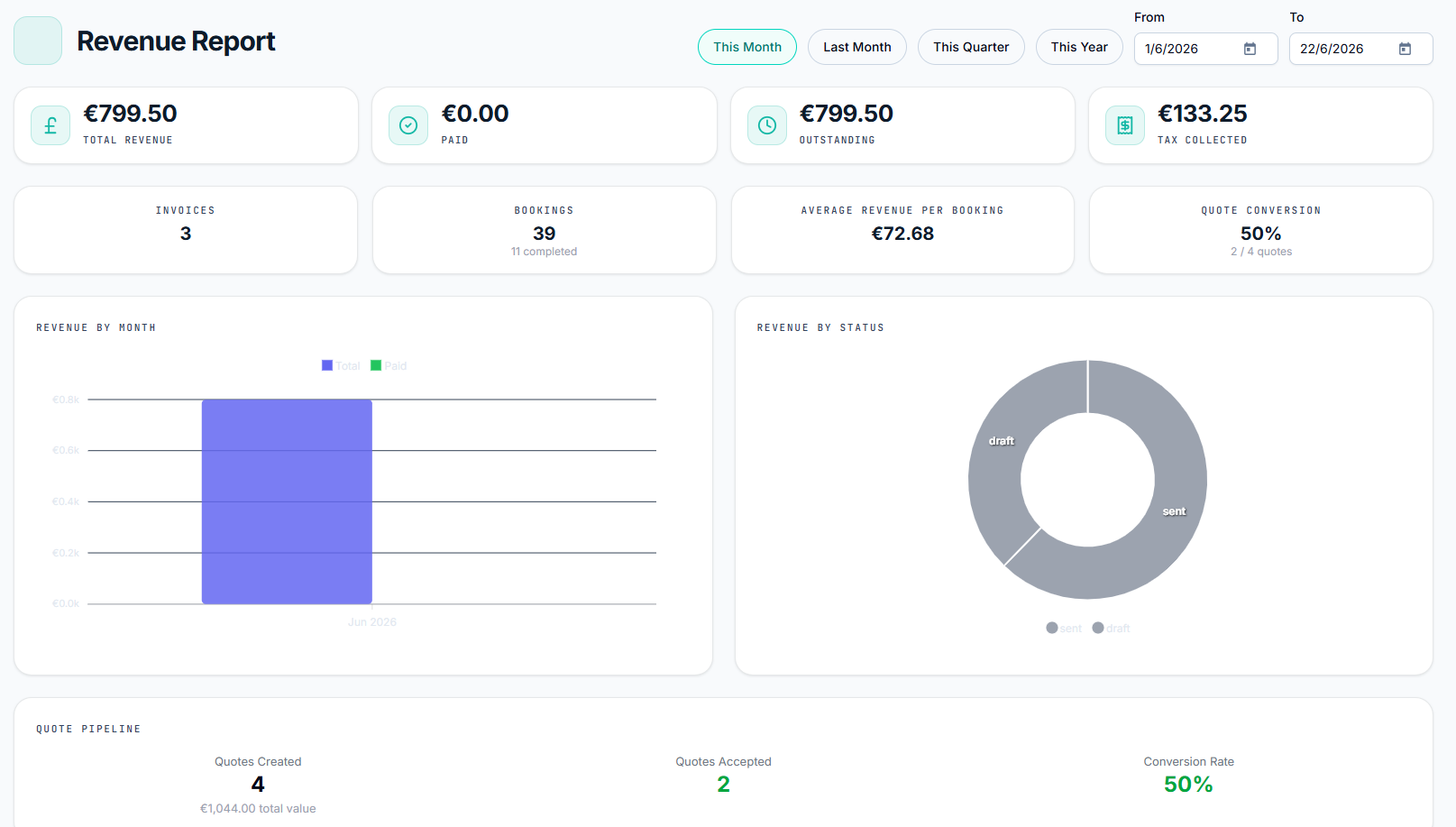
Revenue reporting connects bookings, invoices and quote conversion in one management view.
What AI-powered tour operator software can automate before reporting starts
Good reporting depends on good operational data. If bookings, quotes and invoices are not structured from the beginning, no dashboard can give a reliable picture later.
This is where AI-powered tour operator software becomes useful. The goal is not to replace the operations team. The goal is to reduce repetitive work before it becomes a reporting problem.
For example, an operator may receive enquiries through a website form, WhatsApp message or phone call. The customer asks for a coach from an airport to a hotel, a school trip with several stops or a multi-day tour. If that information is captured manually, the team has to retype details, check prices, prepare a quote, follow up, confirm the booking and move it into dispatch.
When this process is supported by structured software, more of the information can flow from request to quote, from quote to booking and from booking to invoice. With Transitour + AI, the platform can support lead capture from WhatsApp and the website, qualify enquiries, draft quotes and route confirmed bookings to the dispatch board. That means the commercial workflow starts in a more organized way, which makes later reporting more useful.
The value is not only speed. It is consistency. When requests are captured in a structured process, teams have a better chance of tracking what was quoted, what was won, what was delivered and what revenue was generated.
From quote conversion to confirmed revenue
One of the most important metrics for coach and bus operators is quote conversion. A busy sales inbox can create the feeling that demand is strong, but the real question is how many quotes become paid work.
Quote conversion is especially relevant for tour transport, charter bus services, school trips, event shuttles and DMC operations. These requests often require fast response, clear pricing and operational confidence. If a team takes too long to reply, the customer may choose another supplier. If the price is prepared manually, margins may be inconsistent. If accepted quotes are not linked to bookings, the team loses visibility.
A proper revenue report should help managers see more than total income. It should connect the commercial funnel with operational delivery. That includes quotes, accepted bookings, invoices, pending revenue and average revenue per booking.
In Transitour, the revenue report is designed to give financial visibility over bookings, invoices, revenue and quote conversion. For an operator, this helps bring sales and operations into the same conversation. The question is no longer only “how many trips did we run?” but also “how much revenue did those trips create, and how efficiently did we convert demand into confirmed work?”
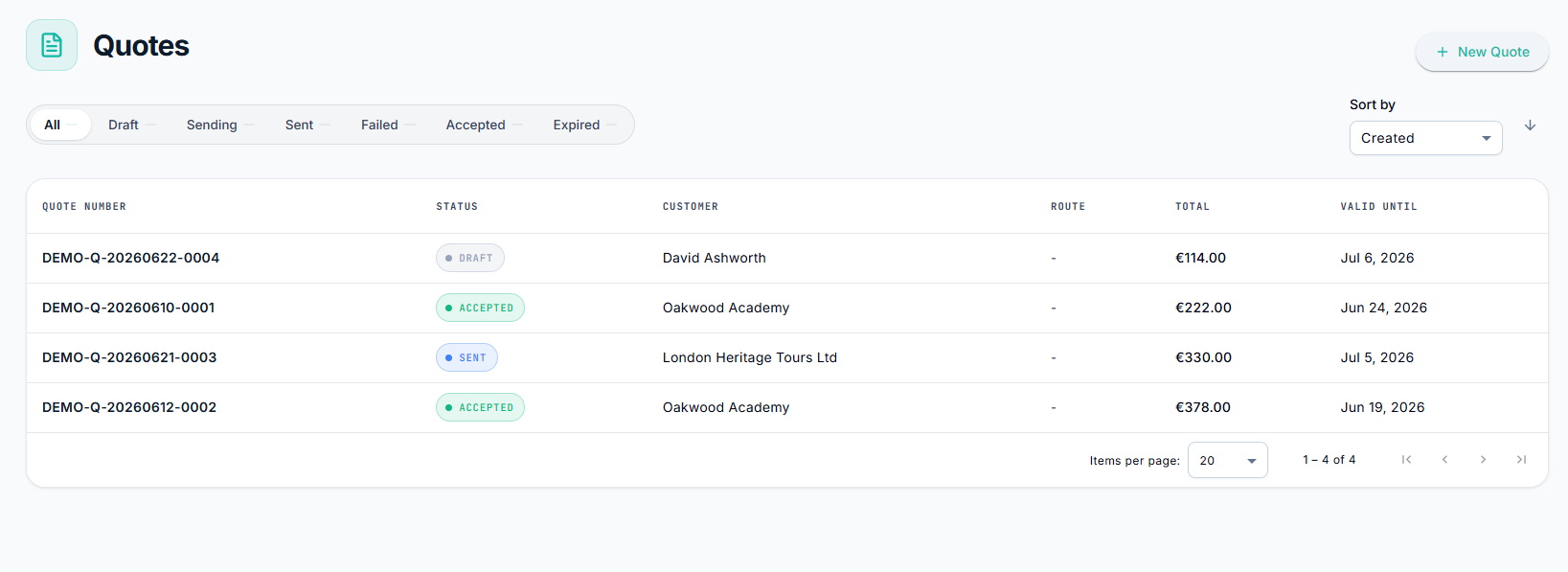
Quote tracking helps teams follow commercial opportunities before they become confirmed bookings.
Revenue reporting should include invoicing visibility
A completed trip is not the end of the commercial process. For the business, revenue only becomes useful when it is invoiced, tracked and collected.
Many operators still manage this stage separately from dispatch. The operations team marks a service as completed, but finance may wait for details, check emails, confirm the route, review the price and create the invoice later. This delay can create cash flow issues and make monthly reporting less reliable.
Revenue reporting for coach operators should therefore include invoice status. Paid, draft, sent, overdue and pending invoices all tell a different story. A company may have a strong month in completed services but still have too much revenue waiting to be collected.
Transitour connects operational activity with invoicing and payment visibility. This helps teams reduce the distance between completed bookings and financial follow-up. It also gives managers a clearer view of what has been earned, what has been invoiced and what still needs attention.
Profitability also depends on fleet utilization
Revenue alone does not show the whole picture. A coach operator can increase sales and still lose efficiency if vehicles are not used well, if the wrong vehicle type is assigned, or if idle capacity is hidden in the schedule.
This is why reporting should also include fleet utilization. Managers need to understand how many vehicles are active, how many hours are assigned, where idle time appears and whether some vehicles are consistently underused.
For example, a company may discover that several vehicles are frequently idle during weekdays, while the team is turning down weekend requests. Another operator may see that one type of vehicle is overbooked while another category has spare capacity. Without reporting, these patterns are easy to miss.
Fleet utilization reporting can help operators make better decisions about pricing, availability, sales focus and future investment. It can also support conversations about whether to add vehicles, reorganize routes, promote certain services or adjust operational planning.
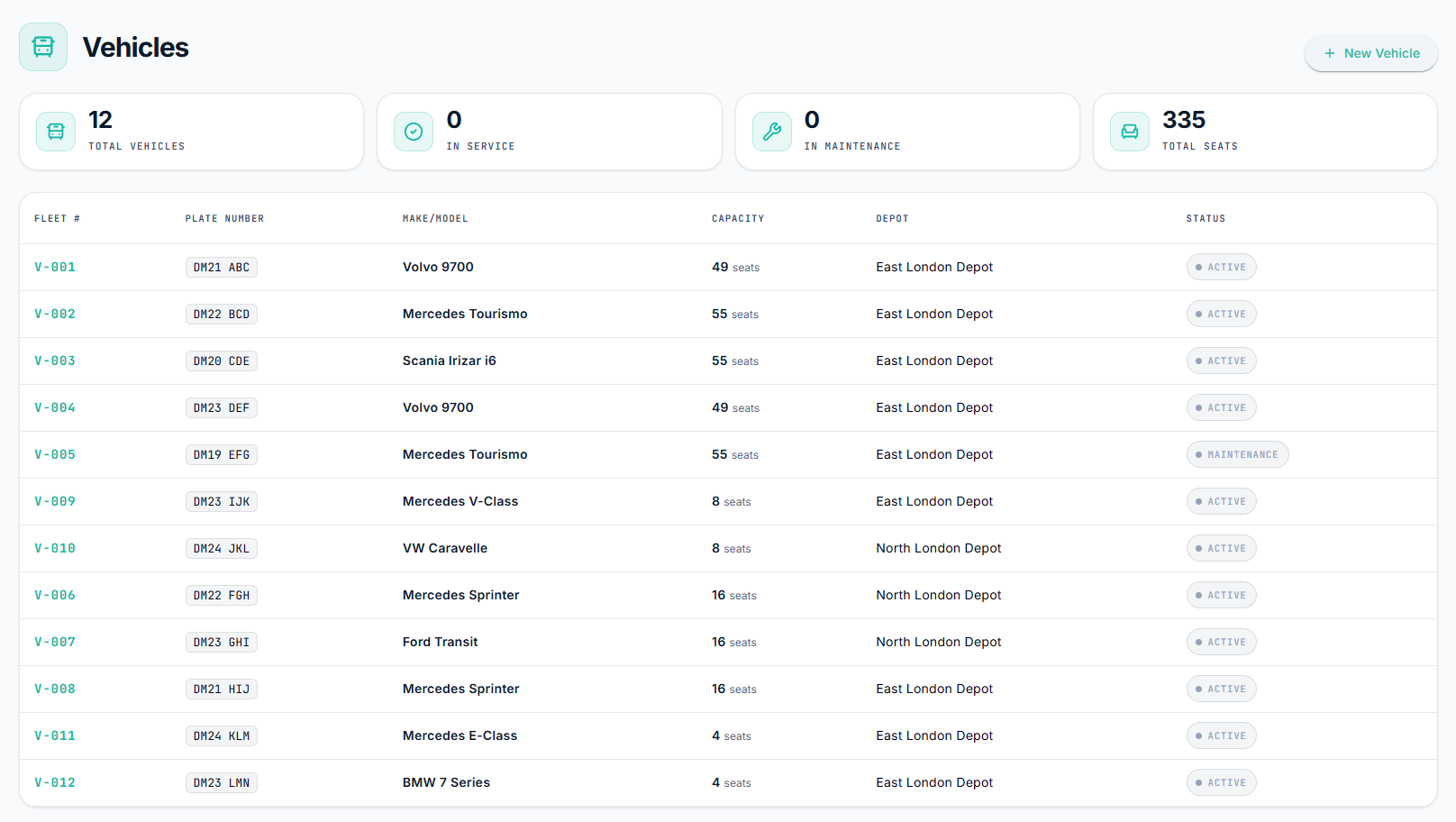
Fleet utilization reporting helps operators identify idle capacity and improve asset usage.
What coach operators should track in a revenue report
A useful revenue report should be simple enough to read quickly, but detailed enough to support decisions. For most coach and bus operators, the following areas are especially important.
Total revenue and pending revenue
Total income gives the headline number, but pending revenue shows where action is needed. If too much revenue is still unpaid, the business may have a cash flow problem even when operations are busy.
Bookings and average revenue per booking
Tracking the number of bookings alongside average revenue per booking helps managers understand whether growth is coming from more work, better pricing or larger services.
Quote conversion
Quote conversion helps teams measure the commercial impact of response times, pricing strategy and follow-up. It also shows whether the company is winning enough of the opportunities it receives.
Invoice status
Paid, sent, draft and overdue invoices should not be hidden in separate tools. They are part of the revenue picture and should be visible to the people responsible for business performance.
Fleet utilization
Vehicle usage helps connect revenue with capacity. A company needs to know not only how much it sold, but how effectively it used its fleet to deliver that work.
How Transitour supports better reporting and automation
Transitour is built around the operational flow that coach and transport teams manage every day: quote, book, assign, dispatch and invoice. Instead of keeping each step in a separate tool, the platform brings the workflow into one structured system.
For reporting, this matters because the data is created as the work moves forward. Quotes can be managed and tracked. Bookings can be followed by status. Completed trips can move closer to invoicing. Revenue reports can connect income, pending payments, invoices, bookings and quote conversion. Fleet utilization reports can show vehicle usage and idle capacity.
For teams using Transitour + AI, automation can also support the earlier commercial stage by capturing leads from WhatsApp and the website, qualifying requests, drafting quotes and helping confirmed bookings move into dispatch. Used carefully, this reduces repetitive admin and gives the business cleaner data for reporting.
The result is not a report for the sake of reporting. It is a clearer way to manage profitability, conversion and operational capacity.
Conclusion: better revenue reporting starts before the month ends
Revenue reporting for coach operators should not be a manual exercise at the end of the month. By then, the team is already trying to reconstruct what happened across quotes, bookings, dispatch notes and invoices.
A better approach is to structure the workflow from the first customer request. When quotes, bookings, dispatch and invoicing are connected, reporting becomes easier, faster and more useful. Managers can see what is converting, what is being delivered, what is waiting to be invoiced and where capacity is being underused.
For coach operators, bus companies, DMCs and tour transport teams, this visibility can support better decisions and more profitable growth.
Want to improve revenue reporting for coach operators without rebuilding your process in spreadsheets? Try Transitour free for 7 days or book a demo to see how quotes, bookings, dispatch, invoicing and reporting can work together in one platform.